Purple Tang
Open Mon–Sat 10am–6pm · Sun 1pm–6pm. Usually ready the same day.
- Kept in our system until you collect
About this fishWhat do these mean?
Overview
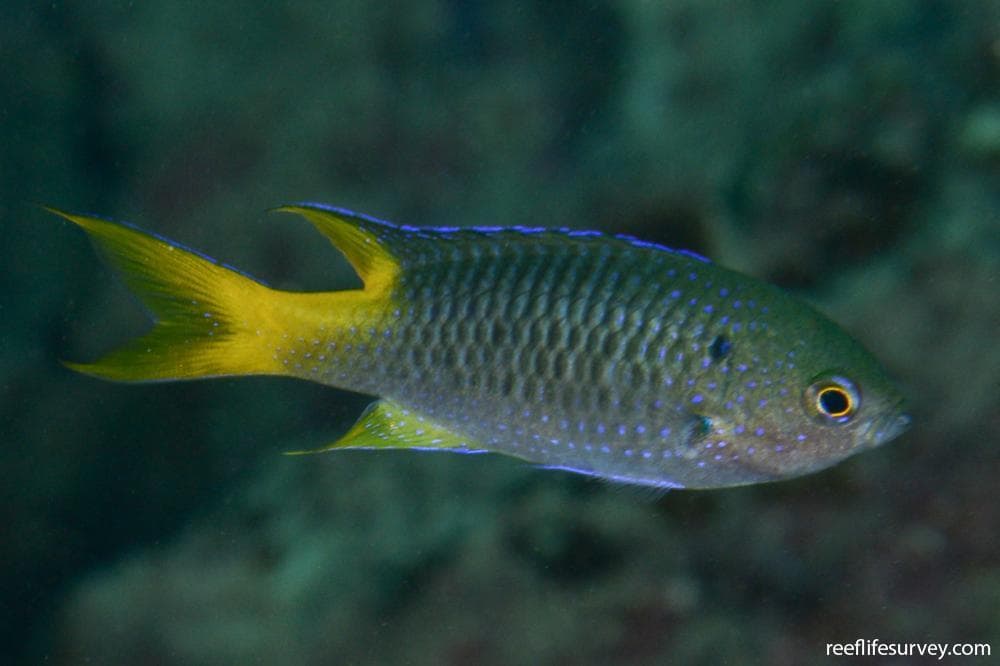
The Purple Tang (Zebrasoma xanthurum) — also called the Yellowtail Sailfin Tang — is one of the most prized surgeonfish in the hobby. A deep, vivid violet body (some lean toward rich indigo) is dusted with fine dark spots across the face and finished with a brilliant yellow tail and yellow-tipped pectoral fins — a genuine jewel under good reef lighting. The best-coloured fish come from the Red Sea, its main stronghold.
Beyond the looks, it's a hardworking algae grazer, scraping filamentous and nuisance algae off the rocks all day, and it's fully reef-safe.
Two honest points shape how you keep it. It grows to a solid 20–25 cm and swims constantly, so it needs a large, established system with real swimming room. And it's one of the feistier tangs — beautiful, but with an attitude to match. We rate it intermediate: hardy once settled, but demanding on space, diet and tankmate selection.
Compatibility
The Purple Tang is generally peaceful toward dissimilar fish, and its hyperactive swimming can even intimidate shy tankmates — but it's well known as one of the more aggressive Zebrasoma tangs. It's territorial toward other tangs, and especially toward similarly shaped ones like the Yellow Tang and its own kind.
Keep one per tank as the rule. To run multiple tangs, use a large system, favour dissimilar shapes and colours, add them all at the same time, and introduce the Purple Tang last so it can't claim the whole tank first. It mixes well with a broad range of robust reef fish — chromis, anthias, wrasses, clownfish, rabbitfish, larger angels — and leaves ornamental shrimp and other inverts alone. Take care with the sharp caudal scalpel when netting, and give it open swimming lanes to keep squabbling down.
Health & quarantine
For a tang, the Purple is reasonably hardy once established, but it carries the usual surgeonfish vulnerabilities: it lacks a heavy body-slime coat and is prone to marine ich and velvet, particularly through the stress of collection and introduction. A proper quarantine period and a slow, drip acclimation are strongly recommended and greatly improve success. It's an active fish that wants strong, oxygen-rich flow and pristine, stable water — it appreciates slightly higher salinity in keeping with its Red Sea origins. Support it with cleaner shrimp or wrasses and a varied, algae-rich diet, which keeps colour vivid, aggression lower and guards against head-and-lateral-line erosion (HLLE). Well cared for, it's long-lived, often a decade or more.
Frequently asked questions
How big does the Purple Tang get, and what tank does it need?
Is it reef safe?
Can I keep it with other tangs?
Why does my new Purple Tang hide or wedge in the rocks?
Do I need to quarantine it?
Is it a good beginner fish?
How collection works
Order & pay online
Check out and pay securely. We set it aside and hold it ready for you.
We get it ready
It stays in our system until you come in — usually ready the same day.
Collect in store
Drop in to 280 North Road, Eastwood, and pick it up.