Bimaculatus Anthias
Open Mon–Sat 10am–6pm · Sun 1pm–6pm. Usually ready the same day.
Tell us the size and sex you're after and we'll source this fish from our suppliers, then email you the moment it's in.
Join the waiting list →- Kept in our system until you collect
About this fishWhat do these mean?
Overview
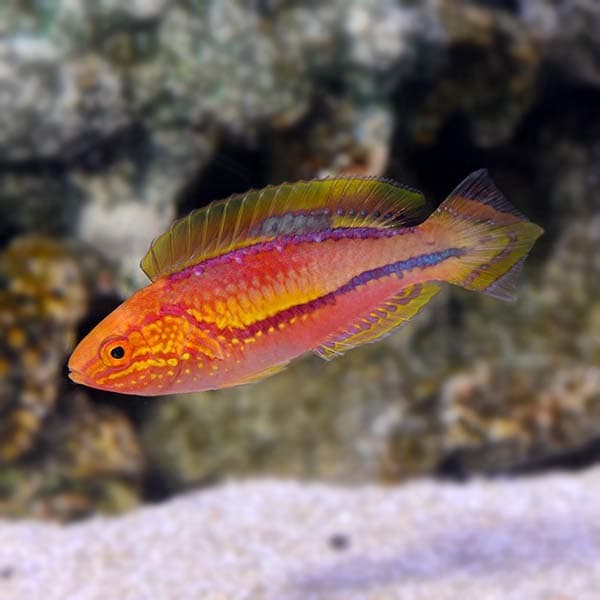
The Bimaculatus Anthias (Pseudanthias bimaculatus) — also called the Twospot or Twinspot Anthias — is one of the most striking anthias in the hobby. Males are the showstoppers: a deep red-to-hot-pink body laced with jagged purple-pink lines, yellow highlights on the head and fins, and the two dark spots on the front of the dorsal fin that give the species its name. Females are softer pink and orange with yellow-edged fins and a yellow line through the eye.
It's a deep-water species, collected from seaward drop-offs and reef walls well below the shallows across the Indo-West Pacific, where it hovers in shoals feeding on plankton.
We'll be honest: this is a rewarding anthias but not a beginner one. It asks for frequent feeding, stable pristine water and a bit of care around its territorial streak, and it can be sensitive when first settling. Meet those needs and few fish add as much colour and movement to the middle of the tank.
Compatibility
Toward unrelated tankmates the Bimaculatus is genuinely peaceful and mixes happily with a wide range of calm community fish. The flashpoint is its own kind: males are strongly territorial, and this species can also be aggressive toward other anthias. In the wild that squabbling plays out across metres of open reef, but in the confines of a tank it can turn serious, so stocking it correctly matters.
Keep a single male with a group of several females, and add the group together — two males in one tank will fight, often fatally for the loser. It's also best practice to keep only one type of anthias per aquarium to avoid interspecific quarrels. Good tankmates include tangs, wrasses, gobies, clownfish and other peaceful species; avoid large or aggressive fish that will intimidate it into hiding.
Health & quarantine
The Bimaculatus is on the more demanding side for an anthias. As a deep-water fish it can be sensitive during collection and settling, and anthias in general are prone to bacterial and protozoan infections, so a proper quarantine period and a slow, unhurried acclimation are strongly recommended — and let you confirm strong feeding before it joins the display. It has a fast metabolism and little fat reserve, so a fish that isn't eating enough declines quickly; buy one you've seen feeding and get it onto frequent meals promptly. Stable, pristine water, hefty filtration and a good skimmer round out its needs. Encouragingly, well-collected specimens often start eating within hours of settling in.
Frequently asked questions
How many should I keep?
Is it reef safe?
Can I mix it with other anthias?
Why does feeding matter so much?
Do the females really turn into males?
Is it a good beginner anthias?
How collection works
Order & pay online
Check out and pay securely. We set it aside and hold it ready for you.
We get it ready
It stays in our system until you come in — usually ready the same day.
Collect in store
Drop in to 280 North Road, Eastwood, and pick it up.