Canary Blenny
Open Mon–Sat 10am–6pm · Sun 1pm–6pm. Usually ready the same day.
Tell us the size and sex you're after and we'll source this fish from our suppliers, then email you the moment it's in.
Join the waiting list →- Kept in our system until you collect
About this fishWhat do these mean?
Overview
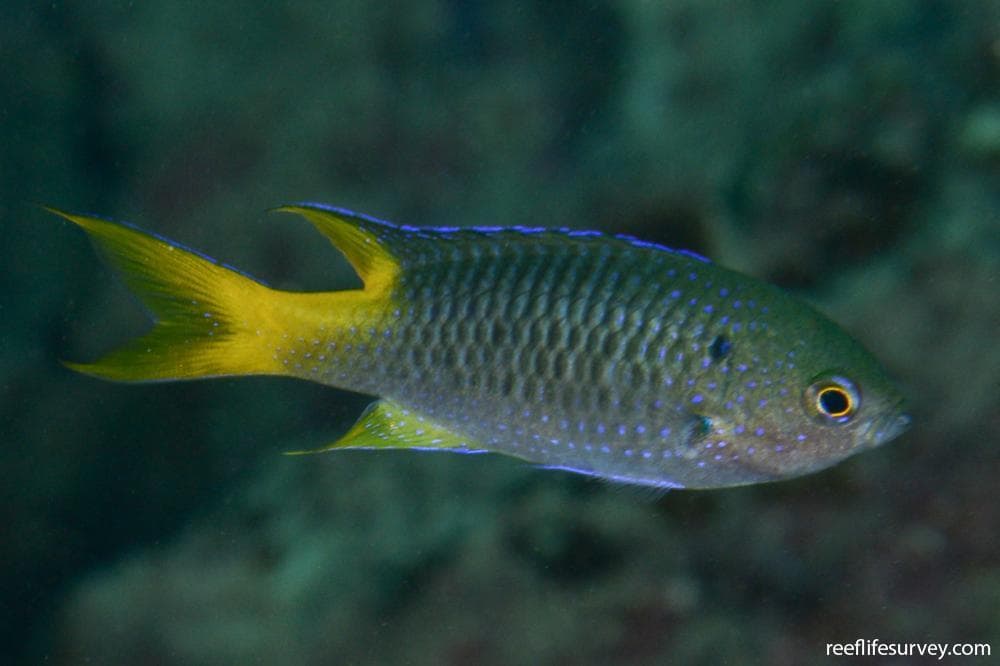
The Canary Blenny (Meiacanthus oualanensis) — also called the Canary Fang or Oualan Forktail Blenny — is a solid, brilliant lemon-yellow fish with an elegant forked tail, and one of the most cheerful splashes of colour you can add to a reef. Unlike most blennies that perch on the rocks, this one behaves more like a wrasse, hovering and darting confidently out in the open water all day.
That boldness comes from its party trick: it's a fang blenny, armed with a pair of small venomous teeth in the lower jaw. The fangs are purely defensive — predators quickly learn to leave Meiacanthus alone — which is exactly why this fish swims out in the open rather than hiding.
It's hardy, reef-safe and widely available as captive-bred stock, which makes it a genuinely great beginner reef fish. It fills a lovely niche too: a bright yellow fish for a nano-to-medium reef where a Yellow Tang would be far too big.
Compatibility
Toward the broad community, the Canary Blenny is peaceful and mixes happily with almost anything — it ignores the cleanup crew entirely, so shrimp, hermits, snails and feather dusters are all safe. Its self-assured nature (courtesy of those fangs) means it holds its own without picking fights.
The one real caveat is lookalikes. It can be territorial toward its own kind and similarly shaped, sized or coloured fish — other fang blennies, combtooth blennies, gobies and dartfish — especially in smaller tanks. Keep just one Canary Blenny per tank unless you have a confirmed mated pair or a very large system, and give any blenny-shaped tankmates a different body shape and niche (a chunky rock-perching lawnmower blenny, for instance, coexists fine). Keep it out of predator displays — a hungry trigger, grouper or moray may strike regardless and come off worse, taking the blenny with it.
Health & quarantine
The Canary Blenny is relatively hardy and easy to keep, particularly captive-bred specimens, which are already weaned onto prepared foods and adapt readily to aquarium life. It does best in a mature, well-established tank with plenty of live rock — this provides both natural grazing and the security it needs, and these fish don't fare well without it. A quiet quarantine period and a calm acclimation are still worthwhile to confirm strong feeding. Two practical points: a tight-fitting lid is essential, as fang blennies are expert jumpers; and while the venom is a defensive tool rather than a hazard in normal keeping, take sensible care during maintenance — don't crowd its territory, never try to hand-feed it, and be mindful around children with tank access, as a defensive bite is genuinely painful.
Frequently asked questions
Is the Canary Blenny's venom dangerous to me?
Is it reef safe?
Can I keep two together?
Do I need a lid?
Is it a good beginner fish?
How is it different from a Midas Blenny?
How collection works
Order & pay online
Check out and pay securely. We set it aside and hold it ready for you.
We get it ready
It stays in our system until you come in — usually ready the same day.
Collect in store
Drop in to 280 North Road, Eastwood, and pick it up.