Blue Throat Trigger
Open Mon–Sat 10am–6pm · Sun 1pm–6pm. Usually ready the same day.
Tell us the size and sex you're after and we'll source this fish from our suppliers, then email you the moment it's in.
Join the waiting list →- Kept in our system until you collect
About this fishWhat do these mean?
Overview
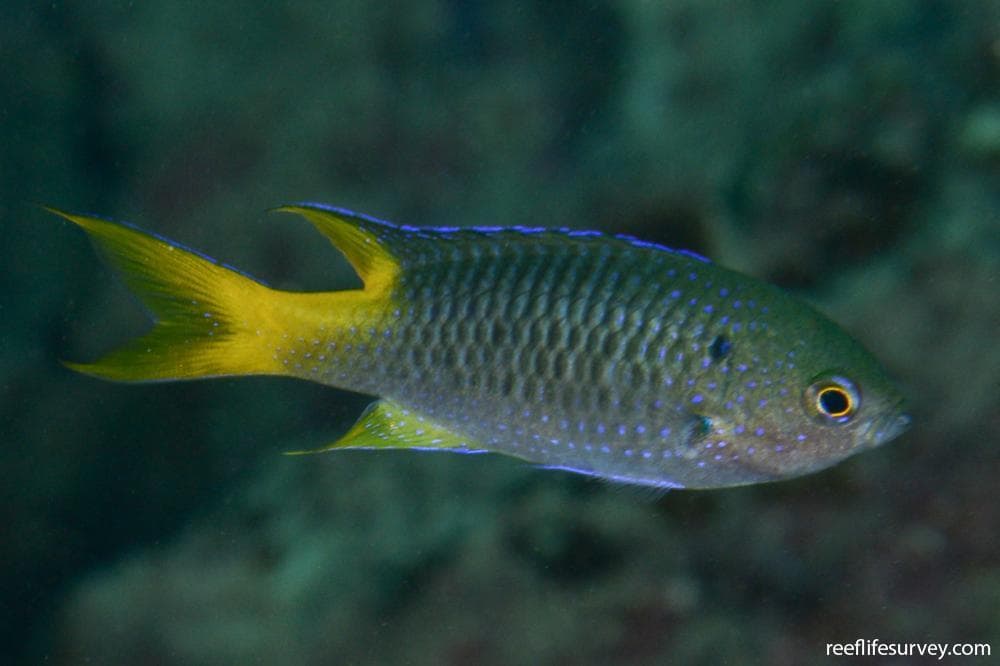
The Blue Throat Trigger (Xanthichthys auromarginatus) — also known as the Bluechin, Bluejaw or Gilded Triggerfish — is the trigger for reef keepers who thought they couldn't keep one. It's a tan-to-grey fish dusted with light-blue spots and trimmed in yellow along the fins, and males carry the signature electric-blue throat that gives the fish its name. Females, lacking that patch, are often sold as Gilded Triggers.
What sets it apart is temperament and diet. This is one of the smallest and most mild-mannered triggerfish in the trade, and unusually for the family it's a mid-water plankton-picker rather than a reef-wrecker. That combination makes it a rare trigger you can realistically consider for a large mixed reef.
We rate it intermediate rather than beginner mainly on account of its size and space needs, plus the honest caveats around small invertebrates. Get the tank size, aquascape and diet right, though, and it's a hardy, intelligent, long-lived fish with real personality — one that soon learns to greet you at the glass.
Compatibility
As triggers go, the Blue Throat is remarkably peaceful and generally leaves its tankmates alone. It suits similarly sized, moderately robust community fish that can hold their own. Keep just one trigger per tank as a rule, or a single male with two or more females in a large system, and add it toward the end of your stocking order so it can't establish dominance before calmer fish settle in.
The honest caveat is with mobile invertebrates rather than corals: it won't harm soft or stony corals, but it may pick at ornamental shrimp, small crustaceans, urchins and feather-duster worms. Very small fish added after it may also be viewed as food. Plan the tank as reef-friendly with corals, but think twice if a shrimp-and-inverts display is your priority.
Health & quarantine
The Blue Throat Trigger is hardy once established, and captive specimens are usually long-lived — often a decade or more. The main hurdle is the start: new arrivals can be shy, reluctant feeders, sometimes taking a week or two before their appetite kicks in, after which they typically become confident, greedy eaters. A quiet quarantine period and patient, unhurried acclimation give it the best chance to settle and let you confirm it's feeding before it joins the display. From there, stable, pristine, well-oxygenated water and a varied diet keep it in good health.
Frequently asked questions
Is the Blue Throat Trigger actually reef safe?
Can I keep more than one?
Why won't my new trigger eat?
Do I need to feed hard-shelled foods?
Will it rearrange my rockwork like other triggers?
Is it a good community fish?
How collection works
Order & pay online
Check out and pay securely. We set it aside and hold it ready for you.
We get it ready
It stays in our system until you come in — usually ready the same day.
Collect in store
Drop in to 280 North Road, Eastwood, and pick it up.