Blonde Lipstick Tang
Open Mon–Sat 10am–6pm · Sun 1pm–6pm. Usually ready the same day.
Tell us the size and sex you're after and we'll source this fish from our suppliers, then email you the moment it's in.
Join the waiting list →- Kept in our system until you collect
About this fishWhat do these mean?
Overview
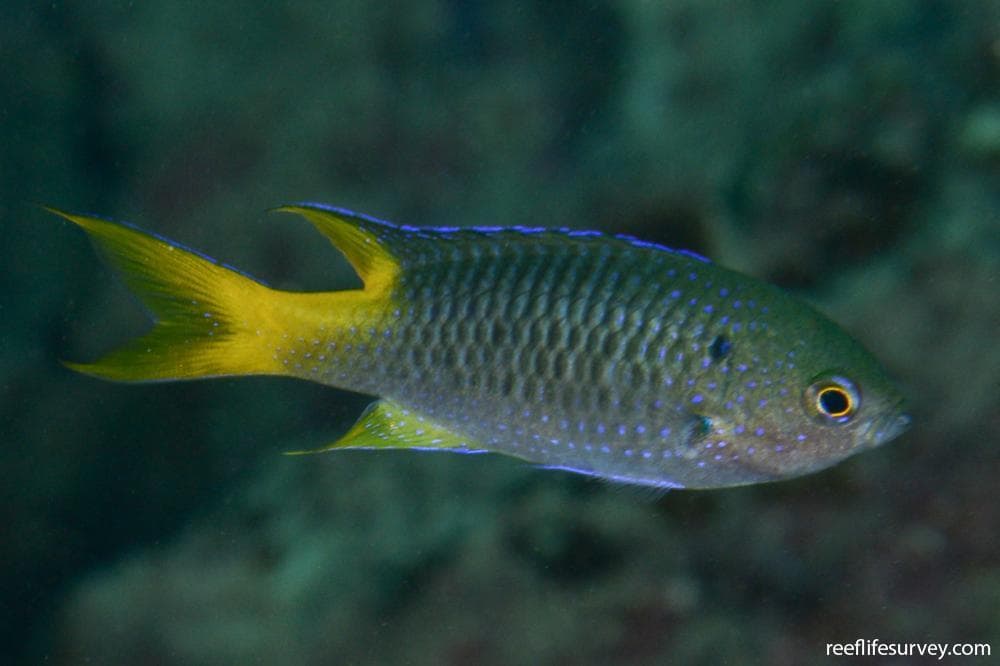
The Blonde Lipstick Tang (Naso elegans) — also called the Blonde Naso or Elegant Unicornfish — is one of the most elegant surgeonfish in the hobby. A smooth bluish-grey body is set off by a vivid yellow 'blonde' dorsal fin, a thin black facial mask, and the signature orange-red 'lipstick' around the mouth, all finished with a lyre-shaped, black-and-white edged tail. Mature males develop long, flowing tail streamers. It's the Indian Ocean cousin of the Pacific Naso (Naso lituratus), and the yellow dorsal is the giveaway between them.
Beyond the good looks, it's an active, graceful algae grazer and — unusually for a tang — a genuinely peaceable community fish, plus it's fully reef-safe.
The honest headline is size and space. This is a big, tireless swimmer that reaches around 40 cm and does fast laps of the tank, so it needs a large, established system. We rate it intermediate: hardy and rewarding once settled and eating, but demanding on tank size, flow and diet, and — like all tangs — prone to ich.
Compatibility
One of the Blonde Naso's best traits is its temperament: it's notably peaceful toward other fish and makes an excellent community tang, happily coexisting with a wide range of species. Where it shows a temper is with other tangs — particularly other Naso and fish of similar shape, size or colour, and most of all other Blonde Nasos.
So the rule is one Naso (ideally one large tang overall) per tank, unless the system is very large. It mixes beautifully with clownfish, wrasses, anthias, angels and most non-surgeonfish. If you're mixing tangs, use a big tank, favour different shapes and colours, and add them together. Cleaner shrimp, cleaner wrasses or neon gobies are a real bonus — this fish benefits greatly from having its parasites picked off. Take care with the sharp fixed keels near the tail when handling.
Health & quarantine
The Blonde Naso is reasonably hardy once established, but it carries the classic tang weakness: it lacks a heavy protective slime coat, which makes it very susceptible to marine ich and velvet, especially through the stress of collection and introduction. A proper quarantine period and a slow acclimation are strongly recommended — ich is common in tangs but readily treated with copper in a quarantine tank. Choose an active, alert fish that isn't looking thin; a poor, skinny specimen is a real challenge. Don't panic if a new arrival doesn't eat for the first day or two, as they usually start within a week. Keep it in a large, mature system with pristine, well-oxygenated water and strong flow, support it with cleaners and an algae-rich diet, and it's long-lived — often 10 to 15 years or more.
Frequently asked questions
How big does the Blonde Lipstick Tang get, and what tank does it need?
Is it reef safe?
Is it aggressive?
Why has my Naso gone blotchy?
How is it different from the regular Naso Tang?
Do I need to quarantine it?
How collection works
Order & pay online
Check out and pay securely. We set it aside and hold it ready for you.
We get it ready
It stays in our system until you come in — usually ready the same day.
Collect in store
Drop in to 280 North Road, Eastwood, and pick it up.