Fish
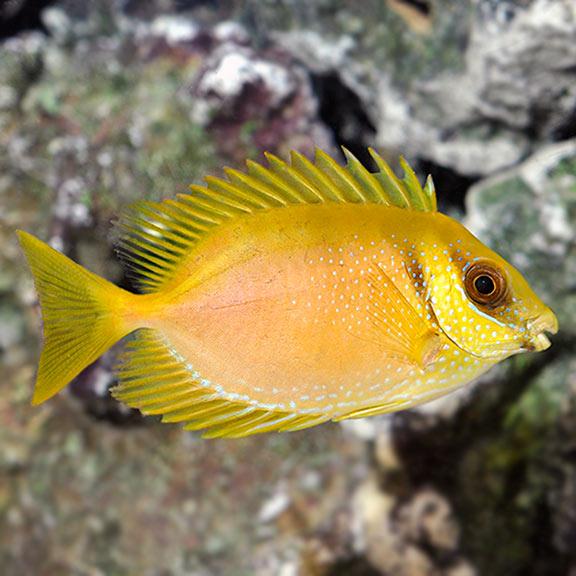
Blue-spotted Rabbitfish
Siganus corallinus (Blue-spotted Rabbitfish) Care Level: Moderate Temperament: Peaceful, but may be aggressive towards its own kind Colour Form: Yellow, Blue Spots Diet: Herbivore Reef Compatible: With caution Water Conditions: 23-26°C, dKH 6-12, pH 7.8-8.4, sg 1.020-1.025 Max Size: 40 cm Family: Siganidae Minimum Tank Size: 400 litres Overview The Siganus corallinus, commonly known as the Blue-spotted Rabbitfish or Coral Rabbitfish, is a vibrant, yellow-bodied fish adorned with striking blue spots. Native to the Indo-Pacific region, this species is popular in the marine aquarium hobby due to its unique appearance and algae-eating habits. Its peaceful nature and ability to help control algae growth make it an ideal candidate for larger reef or fish-only systems, though caution is advised as it may nibble on certain soft corals. Tank Requirements The Blue-spotted Rabbitfish requires a spacious tank, ideally 400 litres or larger, to accommodate its active swimming behaviour and its potential size of up to 40 cm. The tank should have plenty of live rock, which not only provides grazing areas for the fish but also gives it hiding places when it feels threatened. It is generally peaceful with other tank mates, but caution should be taken when keeping multiple Rabbitfish, as they can become territorial towards each other. Diet As a herbivore, the Blue-spotted Rabbitfish primarily feeds on algae. In the aquarium, its diet should include a variety of macroalgae, seaweed (such as nori), and herbivore pellets or flake foods. Supplement its diet with fresh vegetables like blanched lettuce, zucchini, and spinach. While they are effective at controlling algae, they should still be fed regularly to ensure they receive enough nutrition. Care Tips Provide a large, well-established tank with plenty of live rock for grazing. Keep water parameters stable, as Rabbitfish can be sensitive to poor water quality. Monitor the fish’s interaction with corals, as it may occasionally nip at some species. Compatibility The Blue-spotted Rabbitfish is generally peaceful with other fish, making it a good candidate for community tanks. However, it may become aggressive towards its own kind unless housed in a very large tank. Be cautious when introducing them into a reef aquarium as, while they are mostly reef-safe, they might occasionally nip at soft corals or other invertebrates if underfed. Venom Warning Like other Rabbitfish, the Blue-spotted Rabbitfish has venomous spines on its dorsal and anal fins. While the venom is not usually life-threatening, it can cause a painful sting. Care should be taken when handling the fish or performing tank maintenance. With its bright yellow coloration and striking blue spots, the Blue-spotted Rabbitfish is both beautiful and functional in a large marine aquarium. Its algae-eating behaviour helps maintain the cleanliness of the tank, and its peaceful nature makes it an attractive option for community setups.
Photos
About This Item
Siganus corallinus (Blue-spotted Rabbitfish)
Care Level: Moderate
Temperament: Peaceful, but may be aggressive towards its own kind
Colour Form: Yellow, Blue Spots
Diet: Herbivore
Reef Compatible: With caution
Water Conditions: 23-26°C, dKH 6-12, pH 7.8-8.4, sg 1.020-1.025
Max Size: 40 cm
Family: Siganidae
Minimum Tank Size: 400 litres
Overview
The Siganus corallinus, commonly known as the Blue-spotted Rabbitfish or Coral Rabbitfish, is a vibrant, yellow-bodied fish adorned with striking blue spots. Native to the Indo-Pacific region, this species is popular in the marine aquarium hobby due to its unique appearance and algae-eating habits. Its peaceful nature and ability to help control algae growth make it an ideal candidate for larger reef or fish-only systems, though caution is advised as it may nibble on certain soft corals.
Tank Requirements
The Blue-spotted Rabbitfish requires a spacious tank, ideally 400 litres or larger, to accommodate its active swimming behaviour and its potential size of up to 40 cm. The tank should have plenty of live rock, which not only provides grazing areas for the fish but also gives it hiding places when it feels threatened. It is generally peaceful with other tank mates, but caution should be taken when keeping multiple Rabbitfish, as they can become territorial towards each other.
Diet
As a herbivore, the Blue-spotted Rabbitfish primarily feeds on algae. In the aquarium, its diet should include a variety of macroalgae, seaweed (such as nori), and herbivore pellets or flake foods. Supplement its diet with fresh vegetables like blanched lettuce, zucchini, and spinach. While they are effective at controlling algae, they should still be fed regularly to ensure they receive enough nutrition.
Care Tips
- Provide a large, well-established tank with plenty of live rock for grazing.
- Keep water parameters stable, as Rabbitfish can be sensitive to poor water quality.
- Monitor the fish’s interaction with corals, as it may occasionally nip at some species.
Compatibility
The Blue-spotted Rabbitfish is generally peaceful with other fish, making it a good candidate for community tanks. However, it may become aggressive towards its own kind unless housed in a very large tank. Be cautious when introducing them into a reef aquarium as, while they are mostly reef-safe, they might occasionally nip at soft corals or other invertebrates if underfed.
Venom Warning
Like other Rabbitfish, the Blue-spotted Rabbitfish has venomous spines on its dorsal and anal fins. While the venom is not usually life-threatening, it can cause a painful sting. Care should be taken when handling the fish or performing tank maintenance.
With its bright yellow coloration and striking blue spots, the Blue-spotted Rabbitfish is both beautiful and functional in a large marine aquarium. Its algae-eating behaviour helps maintain the cleanliness of the tank, and its peaceful nature makes it an attractive option for community setups.
Available Options
RegularSKU: 6368171
$65.00
Out of stock
Want to See This in Person?
Visit our store in Eastwood to see this item and many others. Our team can answer all your questions.