Overview
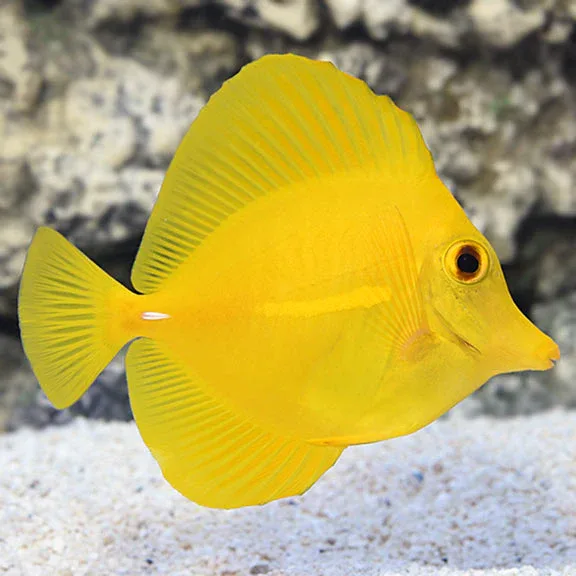
The Yellow Tang (Zebrasoma flavescens) is one of the most recognisable fish in the entire marine hobby — a disc-shaped body in brilliant, uniform buttercup yellow, finished with a fine white caudal spine (the 'scalpel' all tangs carry). It comes from the Central Pacific, most famously the reefs of Hawaii, where it grazes algae across the reef flats by day.
Beyond the looks, it's a genuinely useful fish: an active, all-day grazer that helps keep nuisance algae in check, fully reef-safe, and hardy once properly settled. Captive-bred Yellow Tangs are increasingly available too, and they're well worth seeking out — they tend to be more disease-resistant, already eating prepared foods, and a more sustainable choice.
Honesty matters here, though. This is an active fish that grows to a fair size and needs real swimming room, and like all tangs it's prone to ich and diet-related issues if conditions or nutrition slip. Get the space, diet and water quality right and it's a superb, long-lived centrepiece — which is why we rate it intermediate rather than a true beginner fish.
Compatibility
The Yellow Tang is peaceful enough with dissimilar species but has a clear semi-aggressive streak toward other tangs — especially other Zebrasoma, and any yellow or disc-shaped fish it reads as a rival. As a rule, keep just one per tank unless you're running a large system, and if you want several tangs, introduce them all at the same time so no single fish claims the territory first.
It mixes well with most calm-to-robust community fish — clownfish, wrasses, anthias, gobies and the like — and is best added toward the end of your stocking order to blunt its territorial edge. A quick word of caution: the caudal scalpel is sharp and used in disputes, so take care when netting and be mindful when adding new tankmates.
Health & quarantine
Tangs lack a heavy body-slime coat, which makes the Yellow Tang notably susceptible to marine ich (Cryptocaryon) and velvet, particularly when newly imported or stressed. A proper quarantine period and slow, unhurried acclimation are strongly recommended and dramatically improve long-term success. Once settled, it's hardy — but keeping it that way depends on stable, pristine, well-oxygenated water and a varied, algae-rich diet, which together also guard against head-and-lateral-line erosion (HLLE). Cleaner wrasses, cleaner shrimp and neon gobies are helpful allies, and captive-bred specimens generally prove tougher and quicker to settle than wild-caught fish.
Frequently asked questions
How big a tank does a Yellow Tang really need?
Can I keep two Yellow Tangs together?
Is the Yellow Tang reef safe?
Why has my Yellow Tang gone pale or brown?
Do I need to quarantine it?
What's the best food for keeping its colour?
Care guidance is drawn from our own experience — every fish is an individual, so treat it as a starting point, not a guarantee. Not sure if a species suits your tank? Come ask us in store. New to the terms? Read the care-terms glossary.