Overview
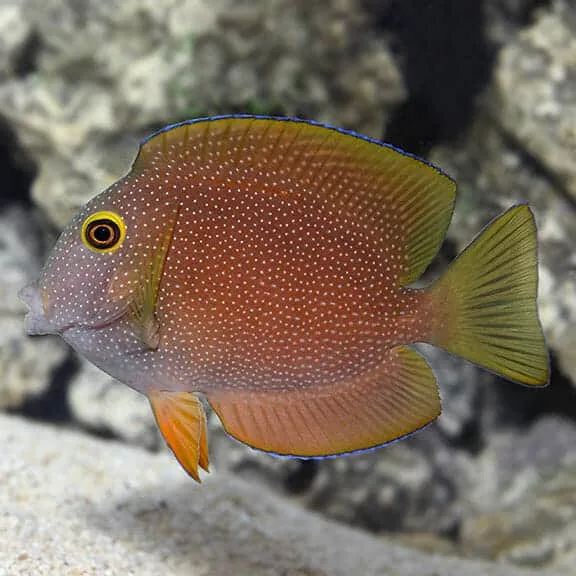
The Yellow Eye Bristletooth Tang (Ctenochaetus strigosus) — better known as the Kole Tang — is one of the most useful and reef-friendly tangs you can keep. Adults wear a deep maroon-to-purple-brown body with fine horizontal striping and freckling, set off by the bold, bright yellow ring around the eye that gives the fish its name. Juveniles start out more golden-tan before darkening with age.
What sets bristletooth tangs apart is the mouth: instead of the rasping teeth of other tangs, they have fine, flexible comb-like bristles that let them scrape film algae and detritus off rock and sand. That makes the Kole an exceptional clean-up grazer — it works surfaces other tangs ignore.
It stays smaller than most tangs at around 18 cm, which lets it fit into more modest systems, and it's relatively hardy and forgiving. Note that genuine Hawaiian-collected Kole Tangs have become scarcer since Hawaii's collection suspension, so availability and price can vary. All told, it's a superb, functional reef fish for an intermediate keeper.
Compatibility
The Kole is peaceful toward most of its tankmates and slots neatly into a community reef — it generally leaves other fish alone and busies itself grazing. Its territorial streak is reserved for other tangs, especially other bristletooths and its own kind, toward which it can be quite assertive.
As a rule, keep one bristletooth (and ideally one tang overall) per tank unless the system is large. If you do want to mix tangs, use different genera and body shapes, add them together, and give everyone plenty of space. Being on the smaller, milder side, a Kole can itself be bullied by larger, more aggressive surgeonfish, so choose its tankmates with that in mind. It's fully safe with corals, shrimp, crabs, snails and clams.
Health & quarantine
The Kole is one of the hardier, more forgiving tangs and is often suggested as a good first tang, but it still deserves proper care. It's reportedly a little less ich-prone than some surgeonfish, yet a quarantine period and a slow, drip acclimation remain strongly recommended. A mature tank with established live rock and natural film algae to graze helps it settle and thrive. Watch the diet closely: bristletooths are susceptible to nutritional issues like colour loss and head-and-lateral-line erosion (HLLE) if underfed on greens, and be cautious with heavy use of activated carbon, which has been associated with HLLE in tangs. Stable, well-oxygenated water and a varied, algae-rich diet keep it in top condition.
Frequently asked questions
Is the Kole Tang reef safe?
What size tank does it need?
Can I keep more than one, or with other tangs?
Is it a good algae eater?
Why are Kole Tangs sometimes hard to find or pricey?
Do I need to quarantine it?
Care guidance is drawn from our own experience — every fish is an individual, so treat it as a starting point, not a guarantee. Not sure if a species suits your tank? Come ask us in store. New to the terms? Read the care-terms glossary.