
Overview
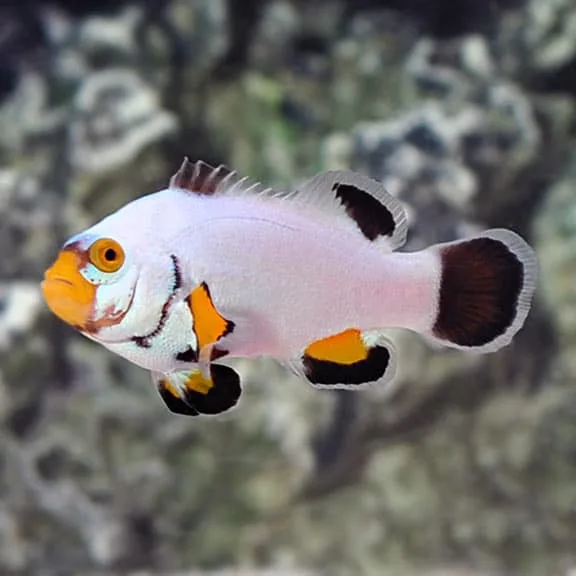
The Platinum Clownfish is one of the most striking designer clowns in the hobby — a nearly pure-white fish finished with crisp black fin margins and a touch of orange around the face. It's a selectively bred strain of the Percula Clownfish (Amphiprion percula), developed over generations from the Picasso Percula lineage, so every one is aquacultured rather than wild-caught.
Because it's captive-bred, it carries all the advantages that come with that: it's hardy, adaptable, already weaned onto prepared foods, and more disease-resistant than wild stock. Add its easygoing nature and reef-safe credentials, and you have a genuine showpiece that's also one of the most beginner-friendly marine fish you can buy.
A quick honest note on the look: because Platinums are bred for that bold white body, patterning can vary a little from fish to fish, and the pure-white finish is exactly what you're paying a premium for. It's a stunning, long-lived fish that suits everyone from first-time marine keepers to seasoned reefers.
Compatibility
Percula clowns are among the most peaceful clownfish, and the Platinum is no exception — it settles quickly into community life and generally minds its own business around a patch of reef. Like all clowns, though, it forms a strict pecking order and can get feisty defending its territory, especially once paired and particularly the dominant female.
Keep it singly or as a bonded pair. If you want two, introduce them together while young; in a pair the larger, more dominant fish becomes the female. Ideally pair a Platinum with another Platinum or a compatible captive-bred Percula, and avoid adding a second clown to one that's already established. It mixes well with most peaceful community fish — gobies, blennies, cardinals, tangs and the like — and should be kept away from large or aggressive species that might bully it.
Health & quarantine
As a captive-bred fish, the Platinum Clownfish is notably hardy and adapts readily to aquarium life, which is a big part of why it's such a good starter marine fish. Even so, a quiet quarantine period and a slow, unhurried acclimation are worthwhile to confirm strong feeding and rule out any issues before it joins the display. Clownfish can be susceptible to brooklynella and marine ich when stressed, so stable, well-maintained water and a low-stress introduction go a long way. Bought healthy and eating, and kept in clean, stable conditions, it's a robust fish that can live well over a decade.
Frequently asked questions
Is the Platinum a Percula or an Ocellaris clown?
Is it good for beginners?
Do I need an anemone?
Can I keep two Platinums together?
Why are Platinums more expensive than regular clowns?
Is it reef safe?
Care guidance is drawn from our own experience — every fish is an individual, so treat it as a starting point, not a guarantee. Not sure if a species suits your tank? Come ask us in store. New to the terms? Read the care-terms glossary.