Overview
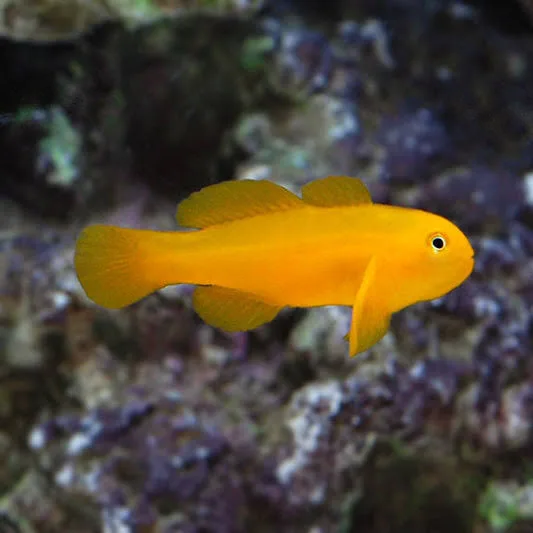
The Coral Goby (Gobiodon spp.) — the group that includes the yellow, green and citron clown gobies — is a tiny, big-personality reef fish that lives its whole life among coral branches. Rarely more than 3–4 cm, with a round, clownish face and jewel-bright colours, it perches on corals and rockwork using fused pelvic fins that work like little suction cups, hopping and darting from spot to spot.
In the wild these gobies settle into a single Acropora colony much as a clownfish settles into an anemone, picking pests off the branches and sheltering (and breeding) among the polyps. They even lack scales, relying instead on a thick, bitter, toxic mucus that makes them taste horrible to would-be predators.
Hardy, endlessly charming and cheap enough to be a centrepiece of a nano reef, the Coral Goby is a brilliant beginner fish — with two honest caveats worth understanding before you buy: it's a small-mouthed, timid feeder, and it has a complicated relationship with SPS corals.
Compatibility
Toward other fish the Coral Goby is exceptionally peaceful — so peaceful, in fact, that it's easily out-competed at feeding time and can be intimidated by boisterous tankmates. Keep it with small, docile species (or in a species/nano tank) so it actually gets its share of food. It's ideal alongside other gentle nano fish.
With its own kind it's a different story: coral gobies are territorial toward conspecifics in small tanks, so keep just one per tank, or a bonded pair. Interestingly, you don't need to sex them — these gobies are bidirectional hermaphrodites, so any two individuals sharing a coral will simply sort themselves into a viable male-female pair. Groups are only realistic in large, coral-rich systems.
Health & quarantine
Coral Gobies are hardy little fish once they're feeding well, but that 'once' matters. Imported specimens sometimes arrive thin and starved with a pinched, shrunken belly, so choose a plump, alert individual — this is the single biggest factor in success. They're small-mouthed and timid, so they need tiny foods and a calm feeding environment, and a mature, pod-rich reef gives them plenty to graze between meals. A quiet acclimation into an established tank suits them far better than a brand-new setup. Kept fed and with gentle tankmates, they're disease-resistant and can live around five to six years.
Frequently asked questions
Is the Coral Goby reef safe?
How big a tank does it need?
Can I keep more than one?
How do I make sure it gets enough to eat?
Why does it sit on the coral instead of swimming around?
Do I need a coral for it, or will rock do?
Care guidance is drawn from our own experience — every fish is an individual, so treat it as a starting point, not a guarantee. Not sure if a species suits your tank? Come ask us in store. New to the terms? Read the care-terms glossary.