Overview
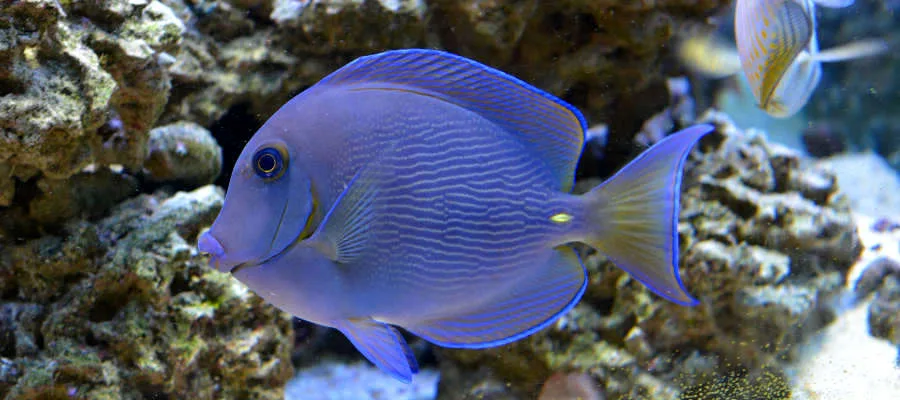
The Atlantic Blue Tang (Acanthurus coeruleus) — also called the Blue Caribbean Tang or Blue Doctorfish — is one of the most fascinating tangs to raise, thanks to a dramatic colour transformation as it grows. Juveniles are a brilliant, sunshine yellow; sub-adults turn blue with a yellow tail; and mature adults settle into a deep royal-to-cobalt blue laced with fine horizontal lines. It's the Atlantic cousin of the Pacific 'Dory' tangs, native to the Caribbean and western Atlantic.
Beyond the looks, it's an active, characterful and hardworking algae grazer, and it's fully reef-safe.
Two honest headlines shape how you keep it. It grows large and, crucially, grows fast — often doubling in size within months — and it becomes noticeably more territorial with age. And Atlantic tangs are especially prone to ich. We rate it intermediate: rewarding and adaptable when started right, but a fish that needs a big, established system, careful quarantine and attentive care.
Compatibility
Toward non-tangs the Atlantic Blue Tang is generally peaceful, but it's territorial toward other surgeonfish — especially other Acanthurus and its own kind — and it gets progressively feistier as it matures, developing genuine bully potential in a tank that's too small. Juveniles are more easygoing; adults, less so.
Keep one tang per tank as the rule. To mix tangs at all, you need a very large system, similar-sized fish of different shapes and colours, and ideally an all-at-once introduction; even then, two Atlantic Blues together is asking for trouble. Add this fish toward the end of stocking a peaceful community so it can't dominate the tank while it's establishing. Take care with the sharp caudal scalpel when netting — it's only extended when the fish is excited, but it can cut deep.
Health & quarantine
This is where the Atlantic Blue earns its intermediate rating. Atlantic tangs are notably susceptible to marine ich and other skin parasites, and this species can be slow to adjust to aquarium life — so a proper quarantine period and a slow acclimation are strongly recommended, with a UV steriliser and good skimmer as worthwhile support. Where possible, choose a juvenile or sub-adult (they adapt more reliably than large adults) that's already feeding well. It needs a large, mature system with pristine, stable, well-oxygenated water and strong flow; its big appetite and bioload will foul a small tank quickly. Support it with a varied, algae-rich diet to bolster immunity and guard against head-and-lateral-line erosion (HLLE), and it can live well over a decade.
Frequently asked questions
Is this the same as the 'Dory' blue tang?
Why is my yellow juvenile turning blue?
How big does it get, and what tank does it need?
Is it reef safe?
Why is quarantine so important for this fish?
Can I keep it with other tangs?
Care guidance is drawn from our own experience — every fish is an individual, so treat it as a starting point, not a guarantee. Not sure if a species suits your tank? Come ask us in store. New to the terms? Read the care-terms glossary.