Overview
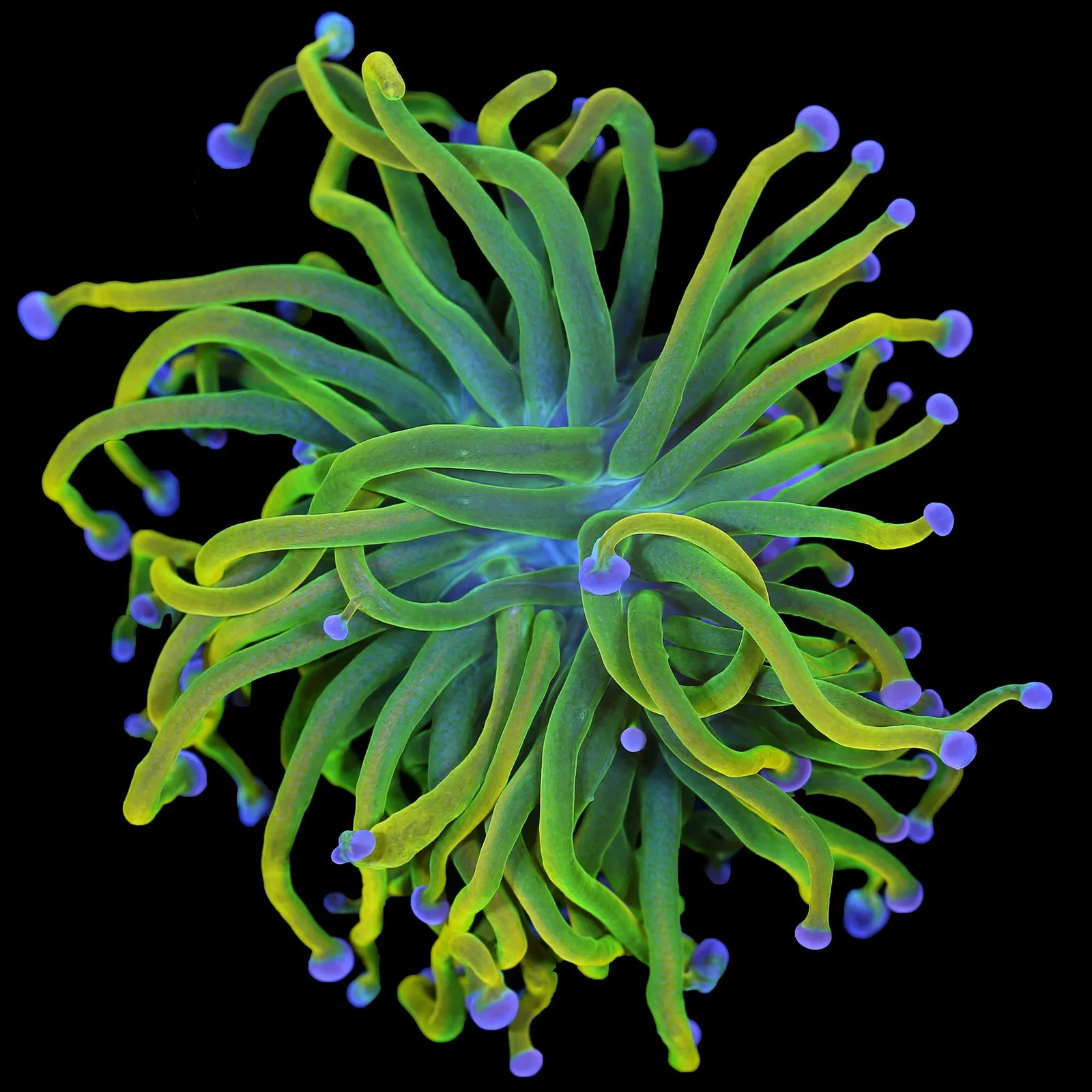
Torch Coral is instantly recognisable by its long, flowing tentacles tipped with a distinct ball or blunt point, giving the flame-like movement in current that gives it its common name. It's a long-standing favourite for its motion and colour range, with gold, green, blue and multi-coloured 'rainbow' torches all available as WYSIWYG pieces.
Like other Euphyllia, it has a branching skeleton with polyps that inflate well past the skeletal structure, so the visual footprint is much larger than the base itself suggests. It's considered a hardy entry point into large-polyp stony coral keeping.
Growth is slow to moderate, with new heads budding off existing branches over time, eventually forming a multi-headed colony.
Placement & neighbours
Torch Coral has some of the longest sweeper tentacles of the commonly kept Euphyllia, so allow generous spacing (20 cm or more) from any neighbouring coral, including on shelves above it. It will sting and can damage slower-growing or less aggressive corals if placed too close.
Best on rockwork in the low-to-mid tank zone with steady, indirect flow; avoid direct blasting flow which can prevent the tentacles from extending naturally.
Health & acclimation
Drip acclimate over 30-45 minutes given known sensitivity to rapid parameter changes. A brief coral dip on arrival helps remove Euphyllia-specific pests such as flatworms and small nudibranchs that specifically target torch tissue. Torch Coral has developed a reputation in some regions for a rapid tissue necrosis ("Torch Coral disease") of uncertain cause, so isolate new pieces in quarantine for 2-4 weeks and monitor closely before adding to the display.
Frequently asked questions
Why did my Torch Coral suddenly lose tissue overnight?
How much space does a Torch Coral need?
Can Torch Coral sting my fish?
Why are the tentacles staying retracted?
Is Torch Coral good for beginners?
Care guidance is drawn from our own experience — every coral is an individual, so treat it as a starting point, not a guarantee. Not sure if a coral suits your system? Come ask us in store.