
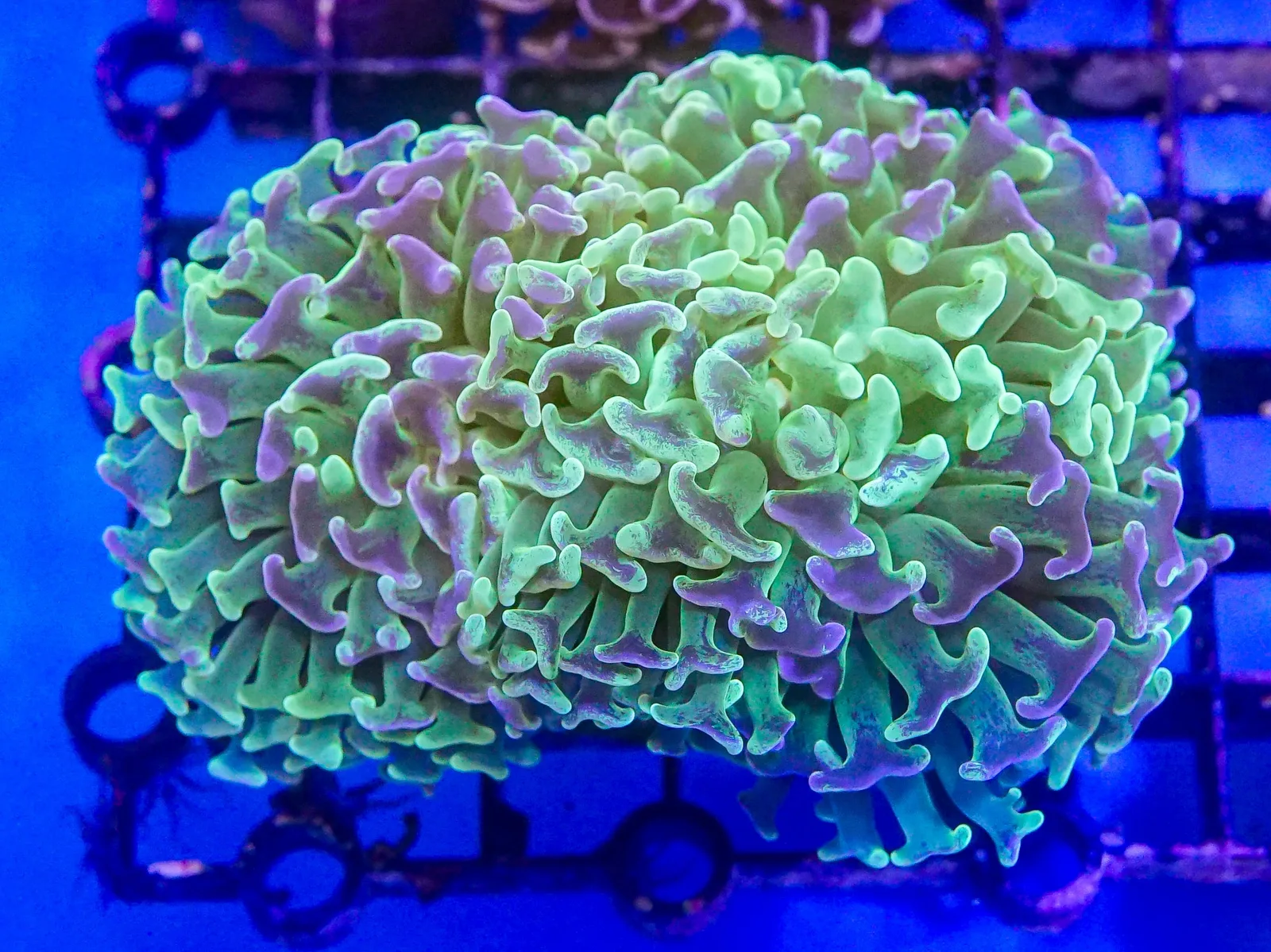
Overview
Hammer Coral is one of the most popular large-polyp stony corals in the hobby, prized for its fleshy, anchor or hammer-shaped tentacle tips that sway gently in current. It forms a branching skeleton with polyps that extend well beyond the skeleton during the day, giving a full, fleshy look that can dominate a display.
Colour forms range from gold and green through to blue-tipped and rainbow varieties, with each frag or colony being a one-of-one WYSIWYG piece. It is a hardy, forgiving coral that adapts well to a range of moderate reef conditions, which is why it's a common recommendation for hobbyists moving into LPS after softies.
Growth is a mix of branching and encrusting at the base, and colonies can become quite large over the years if left undivided.
Placement & neighbours
Hammer Coral carries a stinging sweeper tentacle that can extend several centimetres past the polyp at night or when feeding, so give at least 15-20 cm of clearance from neighbouring corals in every direction, including above. It will win a stinging contest against most soft corals and many LPS if crowded.
Best placed on rockwork in the low-to-mid zone where flow is moderate and steady rather than direct and turbulent, which can prevent full polyp extension.
Health & acclimation
Acclimate slowly using drip acclimation over 30-45 minutes, as Euphyllia species are sensitive to sudden swings in salinity and temperature. A short freshwater or coral-safe iodine dip prior to introduction helps dislodge Euphyllia-specific flatworms and Acropora-eating flatworm hitchhikers, though Hammer is more commonly affected by Euphyllia-eating nudibranchs and flatworms, which are worth checking for on the underside of the skeleton. Watch for recession (tissue pulling back from the skeleton) in the first few weeks, which usually indicates water flow or parameter stress rather than disease.
Frequently asked questions
Why are the polyps not extending fully?
Can I keep Hammer Coral near Torch or Frogspawn?
Is Hammer Coral reef safe with fish?
How do I frag a Hammer Coral?
Why is recession happening at the base?
Care guidance is drawn from our own experience — every coral is an individual, so treat it as a starting point, not a guarantee. Not sure if a coral suits your system? Come ask us in store.